Showing posts with label art. Show all posts

Sunday, October 23, 2011

LINDHAGENPLANEN - 1866

This is the blueprint of modern day Stockholm, created by politician Alber Lindhagen. They bear strong influence from Georges-Eugéne Haussman's plans for Paris.


The rough strokes are the same today, but some things have changed - majorly Norrmalm/Klara/City, one century after this plan was presented.

Sunday, March 6, 2011

Carl-Harry Stålhane (1920-1990) is my favourite ceramicist. He is mostly known for his sophisticated and delicate vessels in various shapes and forms, as well as the many sets of tableware he created for Rörstrand. But he was also a master of the now forgotten and unappreciated reliefed ceramic wall.

For Sparbanken

"Dynamik" for the SAAB headquarters.

Monday, January 3, 2011

Sturegatan 13 & 15, Stockholm

Picture by yours truly, published in the think-tank Östermalmsnytt.

Built between 1966-1970 by Jaenecke & Samuelsson, as "Statstjänstemännens hus" ("House of Civil Servants"). This building always intrigued me. The iregularely placed windows between the bronze coloured anodised aluminum taunts me to figure out a pattern. So far without success. Today asymetry has become the cliché-decoration of choice, but it is a quite rare find in Swedish office architecture from the 60's.


The spacious and light lobby has been rebuilt into something that looks more like a janitor's closet. There used to be a full wall painting here by C.O. Hultén, made in enamel at the ceramics factory of Gustafsberg. I mailed the League of Swedish Officers, which currently uses the building, to ask if there was any possibility of seeing the piece, but with no answer.

I guess they were too busy jerking each other off, planning  picnics in exotic countries like Afghanistan,  or doing whatever the hell else the Swedish defense' been doing for the past 195 years, while hoping they still have a job to go to tomorrow (not bloody likely).

Wednesday, December 22, 2010

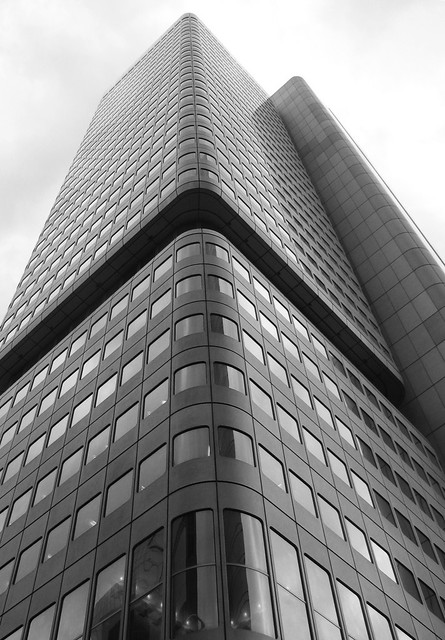
Matthias Hoch - Silver Tower

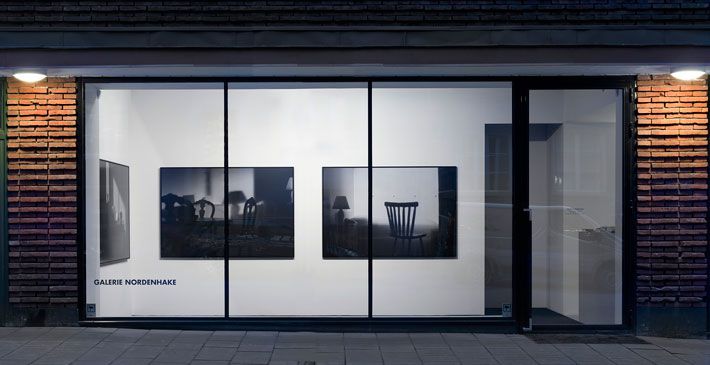
Today is the last day at Galerie Nordenhake Stockholm (Hudiksvallsgatan 8, open until 6) to see Matthias Hoch pictures of the hollow Silver Tower in Frankfurt. The now-defunct Dresdner Bank had famous typographer and designer Otl Aicher together with ABB achitects draw the building - and everything in it - and when it opened in 1978 as the bank's headquarters it stood as the talest building in Germany.

The building's name comes from the aluminum façade it carries. The design is meticulous in every detail - all shapes and objects - including  desks, lightswitches and various buttons, windows and even the floorplan, are shaped as as rounded rectangles. The building must have been immensely expensive to build - ammenities to staff included a pool on the 32nd story, and a conference room secure from wiretapping, with an amazing light installation over it's rounded- edge squared table (see above). Ken Adam, set designer famous from cold-war thrillers such as a number of James Bond flicks, as well as Dr. Strangelove, could not have designed a better set for this paranoid  reality-supersedes-fiction aspect of corporate architecture during the cold war.

But alas, Matthias Hoch is not an architectural photographer per se. The architecture only serves as a backdrop to his socially investigative photography where banal pictures of stacked late-seventies chairs, or a perfectly designed but dusty control panel of unknown use, reveals a lost age - but also a preperation for a new dawn. In early 2009 the Commerzbank took over the Dresdner bank, but since they already have their own headquarters in a later, taller building by Norrman Foster, and because a sale in the midst of the financial crisis was deemed impossible, the building is under renovation by russian workers for future leasing to the Deutsche Bahn. It was during this period that Matthias Hoch had full access to the building, and even though the new owners are opting for  a certificate of the Deutsche Gesellschaft für Nachhaltiges Bauen - approval that the renovation was carried out with the utmost respect for the original design, it is unknown whether the blue and red late-seventies chairs will remain, as well as many of the other designs specifically made for thebuilding.


More information at Galerie Nordenhake.

Archival photos of the Silver Tower:


Sunday, December 5, 2010

Ursa Major


While living in Argentina in the fifties, danish artist-author-designer-inventor-mahematician-poet Piet Hein created this candelabra to remind him of his home. It is modelled after the star constellation Ursa Major, "the Plough", which is only visible from the northern hemisphere.

available from Jackson's


Friday, November 5, 2010


Thursday, August 26, 2010

The Galleries of Hudiksvallsgatan


The art galleries on Hudiksvallsgatan are having the season's first opening today, between 17:00-20:00.


 The building, Industricentralen, was created in 1937 by Ragnar Östberg.


It's really good-looking.


The only decoration to be found is the pattern in which the brick was laid. Two of the spaces here, Galerie Nordenhake and former Brändström & Stene,  were created by Erik Andersson Architects.

The Galleries:                                               Galerie Nordenhake
And an auction house:                               Bukowski's Market
The Swedish clothing brands Whyred and HOPE also have their offices here.

So come on down to this strange place and get yourself a drink.

Monday, August 9, 2010

Constructivism in Design

PK-11 by Poul Kjærholm


from Lushpad

Wednesday, July 7, 2010

Boros Bunker


Christian Boros is a contemporary art collector who purchased an astonishing nazi-classisistic bunker on Friedrichstrasse in the centre of Berlin, and converted into a musuem of his collection. Berlin is full of these fortresses, with concrete walls several metres thick, making them virtually indestructible. There are, of course, two sides to this coin, and the solutions can be... creative, if nothing else:

Social housing projects built around one of these bunkers

The Friedrichstrasse bunker was previously used as vegetable storage, and later a club, which, in a city where you'll find bars in manholes, comes as no surprise. When it was renovated, REALARCHITEKTUR saved as much of the original planning as possible, adding only a staircase, an elevator and only small amounts of white paint. And a penthouse. 

The cost of cutting through the roof and removing 150 cubic metres of reinforced concrete is unknown.


pictures from REALARCHITEKTUR

Thursday, June 3, 2010

White Light/White Heat - Pendants from the 60's


Lars Englund

Tobia Scarpa

Uli Berger

Jørn Utzon
Achille Castiglioni

Jeff Zimmerman

Gino Sarfatti

Verner Panton

Simon Karkov