
When it comes to design and architecture, Norway's contribution tends to be downplayed - something which I can find no good reason for. This is a shame, but below you will find examples of great norwegian architecture by father and son Grung.
LEIF GRUNG
Leif Kuhnle Grung, born 1894, was the pioneer of functionalism in his native Bergen, Norway. Having studied in Stockholm he was heavily inspired by Erik Gunnar Asplund, but also by Frank Lloyd Wright and the Bauhaus. Being the champion of modern architecture in Bergen he became both heavily criticised and highly respected. Kalmarhuset, perhaps his most striking, almost expressionistic, work in Bergen - built from white concrete and dark-red brick, received the following statement from Bergen's most important pre-modernist architect Fredrik Konow Lund: the so-called Kalmarhuset is a school-example of what not to build in a culture-village like Bergen".
In 1945, shortly after the war, Leif Grung was accused of conspiring with the Germans, and was thus expelled from the Bergen Architectural Association. Leif Kuhnle, who was described as having "a remarkable personality with a distinctive artistic nerve" was devastated, and commited suicide.
A few days later, the first prisoners of war returned from Germany, who testified that not only was he falsely accused, but that he had been an intermediary for the escape routes to England, as well as a saboteur of German building plans.
In 1949 he was awarded the Houens Foundations Prize for Good Architecture posthumously for his Blaauwgården building.
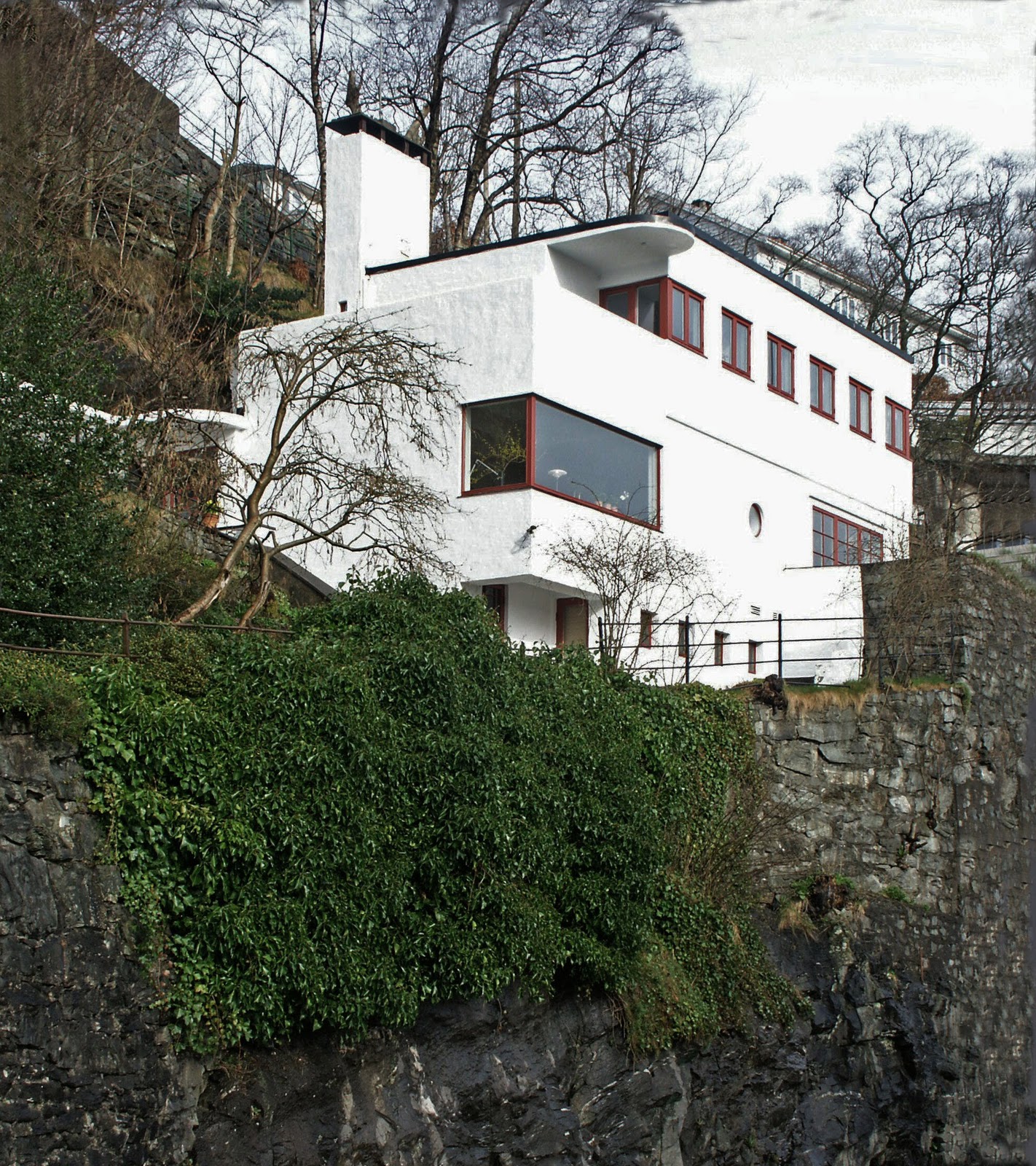
 Villa Lau-Eide, 1935
(photo by Klaas Vermaas)
Kalmarhuset, 1936.

Blaauwgården, 1936. The building is aesthetically divided into two wings to represent its functions: offices on the left - storage to the right. The building also incorporates elements of traditional dock architecture in Bergen.

Sources and further information:
To be continued.

